One moment, six representations: the case for frame-level alignment
High-density data is not more sensors. It is the same physical event represented in several ways that can supervise each other.
Alignment is the multiplier in multimodal physical data. It lets one hour serve perception, world modelling, policy learning, retargeting and simulation at once.
Multimodal is not aligned
Plenty of datasets carry RGB, depth, pose and language simultaneously. Timestamp drift, inconsistent coordinate frames and unstable object identity mean they still cannot form strict supervision.
Alignment has four components: temporal synchronisation, spatial calibration, identity consistency and semantic phase alignment. Missing any one reduces cross-modal supervision to parallel storage.
Fifty-four hours
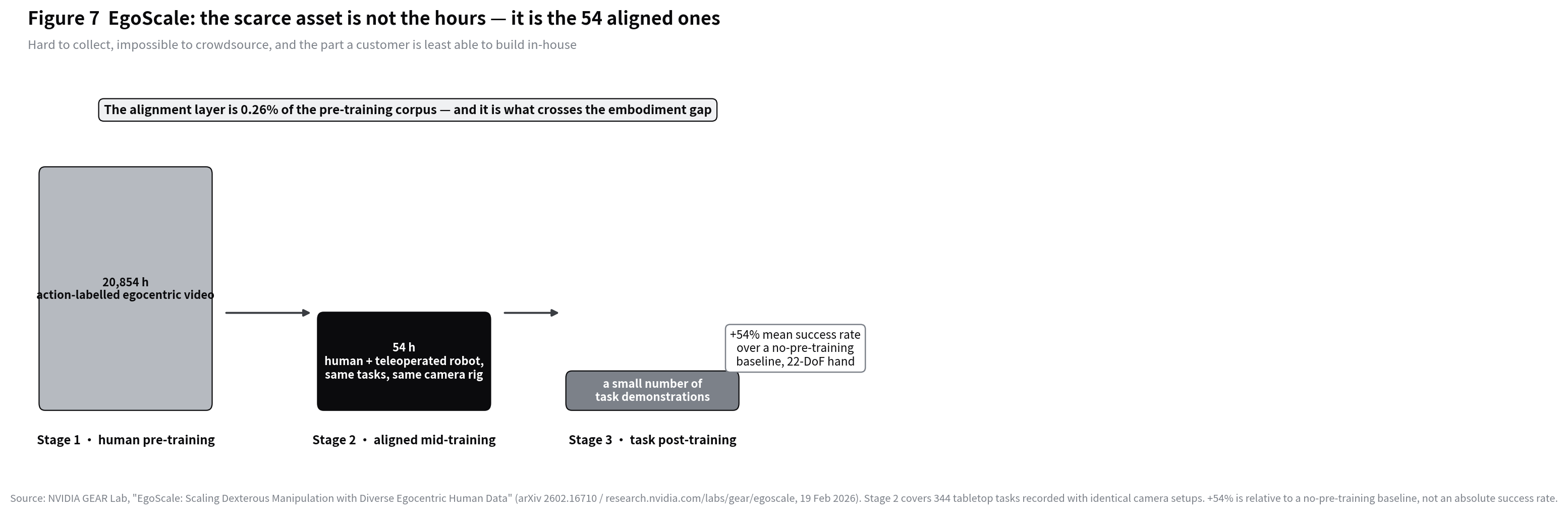
EgoScale provides the clearest published evidence on what alignment is worth. Its structure is three stages: pre-train on 20,854 hours of action-labelled egocentric human video; mid-train on 54 hours in which humans and teleoperated robots performed the same 344 tabletop tasks using identical camera setups; then post-train on specific tasks. The resulting policy improved mean success rate by 54% over a no-pre-training baseline on a 22-DoF dexterous hand, and transferred to lower-DoF hands.
The ratio is the point. Fifty-four hours is about 0.26% of the pre-training corpus. The step that crosses the embodiment gap is roughly one four-hundredth of the data.
Three consequences follow. Large-scale egocentric capture is being commoditised quickly. Paired data — human and robot, same task, same rig, strictly synchronised — cannot be crowdsourced, because it needs robot hardware, a teleoperation stack, task design and calibration in the same room at the same time. And its value is not set by its own duration but by how many pre-training hours it activates.
Why the rest of the field keeps rediscovering this
The alignment problem shows up under several names. Work on human-to-robot data augmentation renders robot embodiments into human footage to close the visual gap, reporting real-world success gains between roughly 3% and 23% across gripper, dexterous and bimanual platforms. Work on active perception recovers synchronised camera and wrist trajectories because the misalignment between head motion and hand motion is what breaks egocentric pre-training. Video-alignment frameworks address viewpoint, action and visual alignment jointly before feeding a policy.
These are different methods aimed at the same deficiency: the modalities exist, and they are not registered to one another. Whether the registration is done in rendering, in trajectory recovery, or at capture time, somebody has to do it. Doing it at capture time is cheaper and more accurate than doing it afterwards.
What alignment buys in training
With strict alignment, cross-modal distillation becomes available: multi-view reconstruction teaches monocular depth, mocap teaches visual hand pose, instrumented contact teaches a visual contact predictor, and robot trajectories provide a backward check on whether a human representation preserved transferable constraints.
Expensive data becomes a teacher for cheap data at scale. That is the financial mechanism behind every layered data strategy worth running.
Turn the claim into measurements
Aligned is not an acceptance criterion. Five figures are: cross-sensor synchronisation error at p50, p95 and p99 in milliseconds; calibration reprojection error in pixels with a validity window; object identity persistence across occlusion and across segments; inter-annotator agreement on task phase labels; and per-layer missing-data rate and confidence distribution.
All five can be written into a contract and independently checked. They are also the fastest way to find out whether a corpus described as multimodal actually is.
Three checks for your own pipeline
None of these require a vendor. All three are computable from data most teams already hold.
1. Can you name the five alignment numbers for your own corpus?
Synchronisation error distribution, reprojection error, identity persistence, phase-label agreement, per-layer missing rate. Most teams can produce none of them on request.
2. Do you hold any strictly paired human-and-robot data?
Not human data and robot data in the same catalogue — the same task, same rig, same timeline. If the answer is no, the embodiment gap is being crossed by inference rather than by evidence.
3. Which layer is teaching which?
A multimodal corpus with no declared teacher-target relationships is usually a storage decision rather than a training one.
Six modalities are useful. Six aligned views of the same moment are transformative.
References
- NVIDIA GEAR Lab, "EgoScale: Scaling Dexterous Manipulation with Diverse Egocentric Human Data", arXiv 2602.16710, 19 February 2026; project page, research.nvidia.com/labs/gear/egoscale. The 54% figure is relative to a no-pre-training baseline, not an absolute success rate.
- "H2R: A Human-to-Robot Data Augmentation for Robot Pre-training from Videos", arXiv 2505.11920 — 3.3% to 23.3% real-world success gains across platforms.
- "ActiveMimic: Egocentric Video Pretraining with Active Perception", arXiv 2606.06194, June 2026.
- "Robot Learning from Human Videos: A Survey", arXiv 2604.27621, 2026 — on viewpoint, action and visual alignment frameworks.
Three checks for your own pipeline
Synchronisation error distribution, reprojection error, identity persistence, phase-label agreement, per-layer missing rate. Most teams can produce none of them on request.
Not human data and robot data in the same catalogue — the same task, same rig, same timeline. If the answer is no, the embodiment gap is being crossed by inference rather than by evidence.
A multimodal corpus with no declared teacher-target relationships is usually a storage decision rather than a training one.
Five supply models, not one market
Why raw hours went to zero, how supply split into five structurally different businesses, and what became scarce instead.
ReadHuman2Robot: the embodiment gap is partly a representation problem
A human hand trajectory is not a robot action. What transfers is contact, object motion, constraints and outcome.
Read